dbt Project Structure
Organize models, sources, tests, macros, documentation and configuration into maintainable projects.
Equip your data teams with practical dbt and Modern ELT skills to transform, test, document and deploy analytical data using SQL, modular models, version control and modern data warehouse practices.
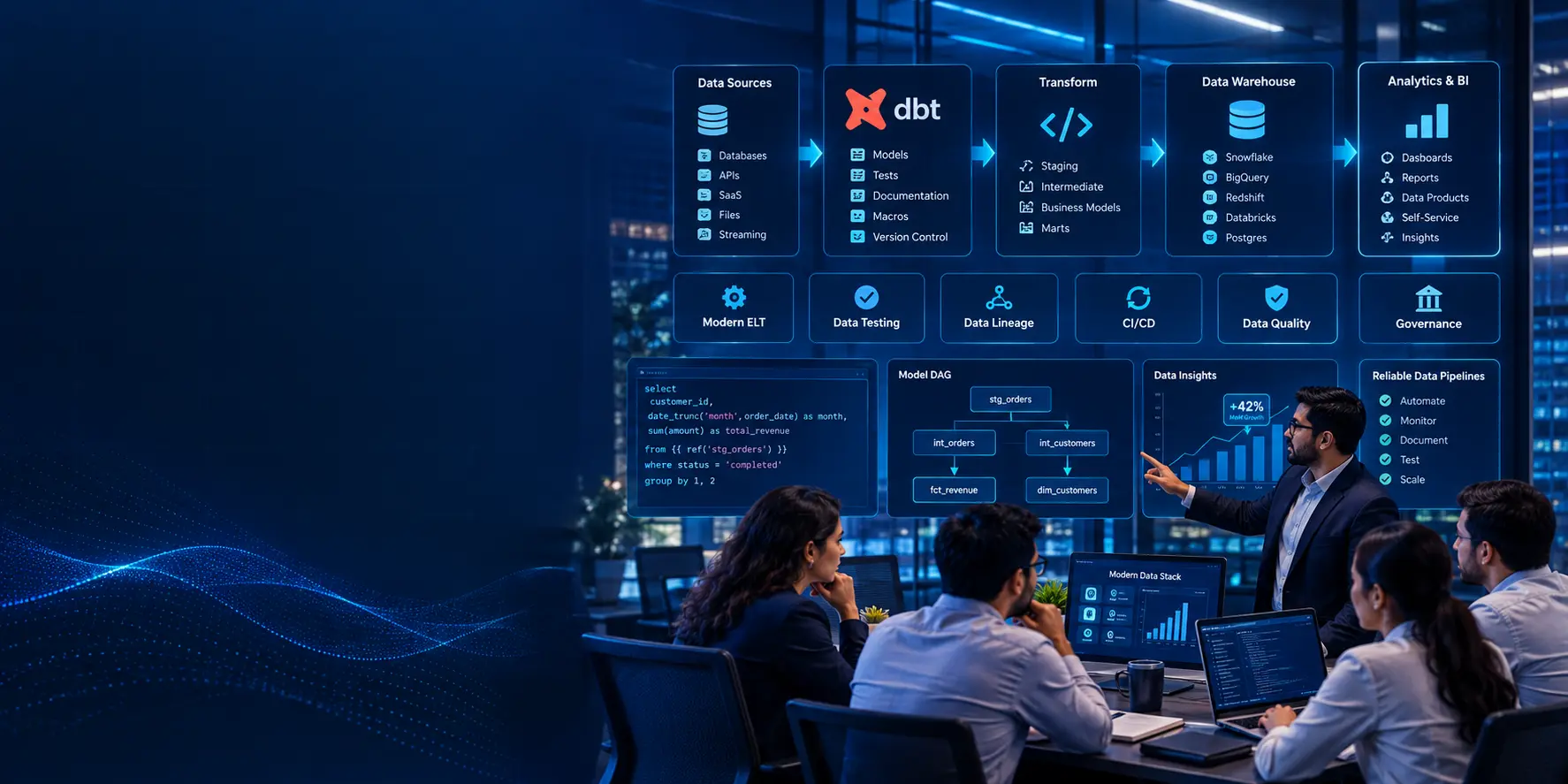
Corporate dbt training at Crystalspiders focuses on SQL-driven data transformation, modular modeling, testing, documentation, lineage and software-engineering practices for analytics teams. The program can connect these practices with the Modern ELT architecture already used by your organization.
Organize models, sources, tests, macros, documentation and configuration into maintainable projects.
Build staging, intermediate and business-facing models using reusable SQL transformation patterns.
Apply model and data-quality checks to improve confidence in analytical transformations.
Document models and business logic so transformation workflows become easier to understand and support.
Integrate dbt projects with Git-based collaboration, automated checks and deployment workflows.
Understand model relationships, references and lineage across increasingly complex transformation projects.
The curriculum can be tailored to your warehouse, SQL standards, deployment approach and existing analytics engineering practices.
Connect analytical workflows to source data already loaded into the organization's data platform.
Create consistent staging models that standardize source structures and naming conventions.
Build modular business transformations using SQL models and reusable logic.
Validate important model assumptions and document the transformation layer for wider teams.
Integrate source control, CI/CD and operational checks into repeatable ELT delivery workflows.
Prepare trusted dimensional, reporting and analytical models for downstream BI teams.
Implement SQL-based transformation layers directly where analytical data is stored.
Use source control and review practices to manage analytics code as an engineering asset.
Build validation into transformation workflows and identify issues before downstream use.
Make relationships among transformed models easier to understand and maintain.
Connect analytics transformation projects with automated validation and deployment routines.
The course can be adapted to your current warehouse and analytics engineering environment.
dbt & Modern ELT training at Crystalspiders helps data teams organize warehouse transformations as maintainable, version-controlled projects. The program focuses on SQL-based models, dependencies, reusable logic, testing, documentation and deployment practices for analytics engineering.
The training can cover staging and business transformation layers, model references, incremental processing, macros, data-quality checks, documentation, lineage and CI/CD workflows. This supports teams that want to manage analytical transformation code with the same engineering discipline used for other software development work.
Corporate delivery can be aligned to your warehouse platform and existing data architecture. Teams can work through practical scenarios involving reporting models, business transformations, testing, documentation and deployment workflows.
The program covers dbt fundamentals, analytics engineering, SQL models, staging and intermediate transformations, model dependencies, tests, documentation, macros, incremental models, references, project organization, CI/CD and production-oriented ELT workflows.
The training is suitable for analytics engineers, data engineers, SQL developers, BI professionals, ETL developers and technical team members who build or support analytical data transformation workflows.
Yes. The course focuses on practical model development using SQL, project structure, dependencies, reusable transformations, tests, documentation and deployment-oriented workflows.
Yes. Participants learn how testing can be incorporated into dbt workflows to validate analytical models and improve confidence in transformed data.
Yes. The curriculum covers documentation, model descriptions, metadata, dependencies and lineage concepts so teams can make transformation logic easier to understand and maintain.
Yes. Corporate delivery can be aligned to your team's SQL standards, warehouse platform, existing ETL processes, transformation architecture, CI/CD workflow, data-quality practices and business use cases.
Discuss your warehouse, transformation workflows and preferred corporate training format with Crystalspiders.