ETL Architecture & Design
Source-to-target mapping, staging strategies, reusable components, modular packages and enterprise ETL architecture.
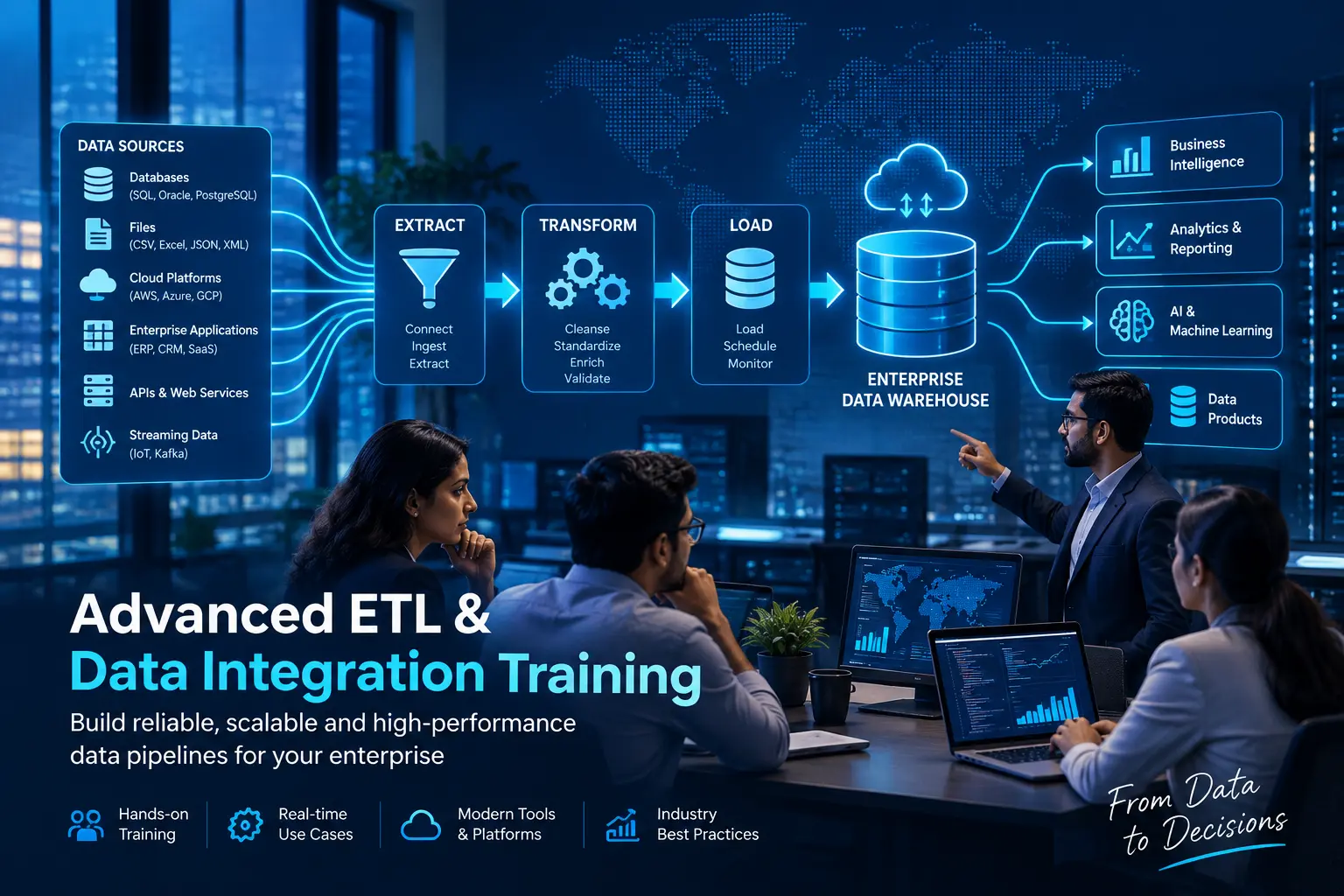
Equip your data and technology teams with practical skills to design, build and optimize advanced ETL and data-integration solutions. The training focuses on incremental processing, change data capture, slowly changing dimensions, data quality, error handling, performance engineering, monitoring and maintainable pipeline architecture.
Reusable pipeline engineering
Efficient change processing
Reliable enterprise connectivity
Faster and scalable pipelines
Reliable data operations
Advanced ETL & Data Integration training is designed for teams that already understand SQL, databases or basic ETL and want to move toward enterprise-grade pipeline engineering. Participants learn how to structure data flows, handle high-volume changes, make loads restartable, manage failures and build solutions that are easier to operate.
The program can be delivered around your organization's technology stack and business scenarios, with practical exercises that connect source systems, staging areas, transformations, target data platforms and downstream analytics workloads.
The curriculum can be adjusted to the organization's data architecture, toolset and project requirements.
Source-to-target mapping, staging strategies, reusable components, modular packages and enterprise ETL architecture.
Watermarks, last-modified approaches, high-water marks, restartability and efficient incremental processing patterns.
Change detection, change data capture concepts, inserts, updates, deletes and source-system synchronization strategies.
Type 1 and Type 2 dimension processing, effective dates, surrogate keys, historical tracking and reconciliation.
Reject flows, logging, checkpoints, retries, restartable pipelines and exception management for production workloads.
Reduce bottlenecks using efficient joins, partitioning considerations, parallel processing, memory-aware transformations and batch design.
Completeness, accuracy, duplicates, reconciliation, business rules, validation checks and controlled exception handling.
Configuration-driven pipelines, reusable mappings, parameterization and design patterns that reduce repetitive development.
Pipeline execution metrics, logging, alerting, operational dashboards and practices for production support.
Relational databases, files, APIs and heterogeneous source systems with appropriate staging and target strategies.
Job orchestration concepts, dependency handling, sequencing, failure paths and operational readiness.
Unit and integration testing, source-target reconciliation, regression checks and controlled deployment practices.
The training emphasizes the decisions that make ETL solutions dependable in production: how to process only changed data, how to preserve history, how to recover from failures, how to validate target data and how to keep pipelines efficient as volumes grow.
Identify reliable source extraction patterns and reduce unnecessary reads.
Use staging and control tables to support traceability and restartability.
Apply scalable transformation, business-rule and data-quality patterns.
Load target structures efficiently while preserving integrity and history.
Reconcile source and target data and route exceptions for analysis.
Track execution, failures and operational indicators for support teams.
Typical corporate scenarios include modernization, data warehouse loading, operational integration and analytics enablement.
Design repeatable pipelines for facts, dimensions and historical data.
Move and synchronize data between operational and analytical systems.
Refactor legacy ETL processes into reusable, scalable pipeline patterns.
Prepare trusted, timely data for BI, reporting and downstream analytics.
Manage CSV, Excel, flat-file and scheduled batch ingestion scenarios.
Improve recoverability, logging, monitoring and supportability of ETL jobs.
Corporate programs can be aligned with the technologies used by your teams. Examples include SQL Server and SSIS, PostgreSQL, Oracle, relational data warehouses, file-based integration, APIs and modern data-engineering platforms.
Tool-specific exercises can be selected according to the team's current projects, migration roadmap and operational needs.
Strengthen pipeline design, transformation and production practices.
Move from database programming into scalable data integration.
Improve ingestion, transformation, quality and operational engineering patterns.
Build stronger upstream pipelines for reporting and analytics workloads.
Standardize ETL architecture, development practices and delivery approaches.
Evaluate integration patterns for reliability, scalability and maintainability.
Design modular and maintainable ETL pipelines.
Implement reliable incremental loading and change-processing patterns.
Process historical changes with appropriate SCD strategies.
Build validation, reconciliation and exception-handling controls.
Diagnose pipeline bottlenecks and improve ETL performance.
Improve logging, monitoring, restartability and operational support.
Crystalspiders corporate Advanced ETL & Data Integration training helps teams build practical expertise in enterprise ETL, data integration and production data pipelines. The content covers ETL architecture, source-to-target mapping, staging, incremental data loading, change data capture, Slowly Changing Dimensions, data quality, error handling, monitoring and performance tuning.
The program is particularly relevant for organizations working with SQL Server and SSIS, relational databases, data warehouses, operational data stores and heterogeneous source systems. Participants learn how to move beyond simple batch jobs and design pipelines that are scalable, testable, restartable and easier to support.
Advanced ETL concepts such as metadata-driven processing, reusable components, parameterization, dependency management, validation frameworks and operational logging can help teams standardize development across data-integration projects. The training can also connect ETL engineering practices with broader Data Engineering, Databricks, BI and modern analytics initiatives.
Answers to common questions about the corporate ETL training program.
It is a corporate training program focused on designing, developing, testing and optimizing enterprise ETL and data-integration pipelines, including incremental loading, change data capture, slowly changing dimensions, error handling, data quality, performance tuning and operational monitoring.
The course is suitable for ETL developers, SQL developers, data engineers, BI developers, database professionals, integration specialists, technical leads and architects who work with enterprise data pipelines.
Yes. The curriculum can cover advanced SSIS patterns along with broader ETL engineering practices such as incremental loads, lookup and cache strategies, reusable components, package design, logging, error handling, dependency management and performance optimization.
Yes. Incremental extraction and loading, change data capture approaches, watermark techniques and Slowly Changing Dimensions are core topics for building maintainable enterprise data pipelines.
Yes. Corporate delivery can be aligned to the organization's databases, ETL tools, data models, integration patterns, deployment process and representative business use cases, subject to technical and training requirements.
Yes. The course includes practical approaches to pipeline performance, parallel processing, partitioning considerations, efficient transformations, bottleneck analysis, data validation, reconciliation, reject handling and operational monitoring.
Discuss your team's current data stack, project requirements and preferred delivery format with Crystalspiders.