DAG & Task Design
Build readable DAGs, tasks, dependencies, task groups and reusable workflow patterns.
Equip your data engineering teams with practical Apache Airflow skills to design, schedule, automate and monitor production-oriented workflows across ETL, ELT, Python, SQL, APIs, cloud services and modern data platforms.
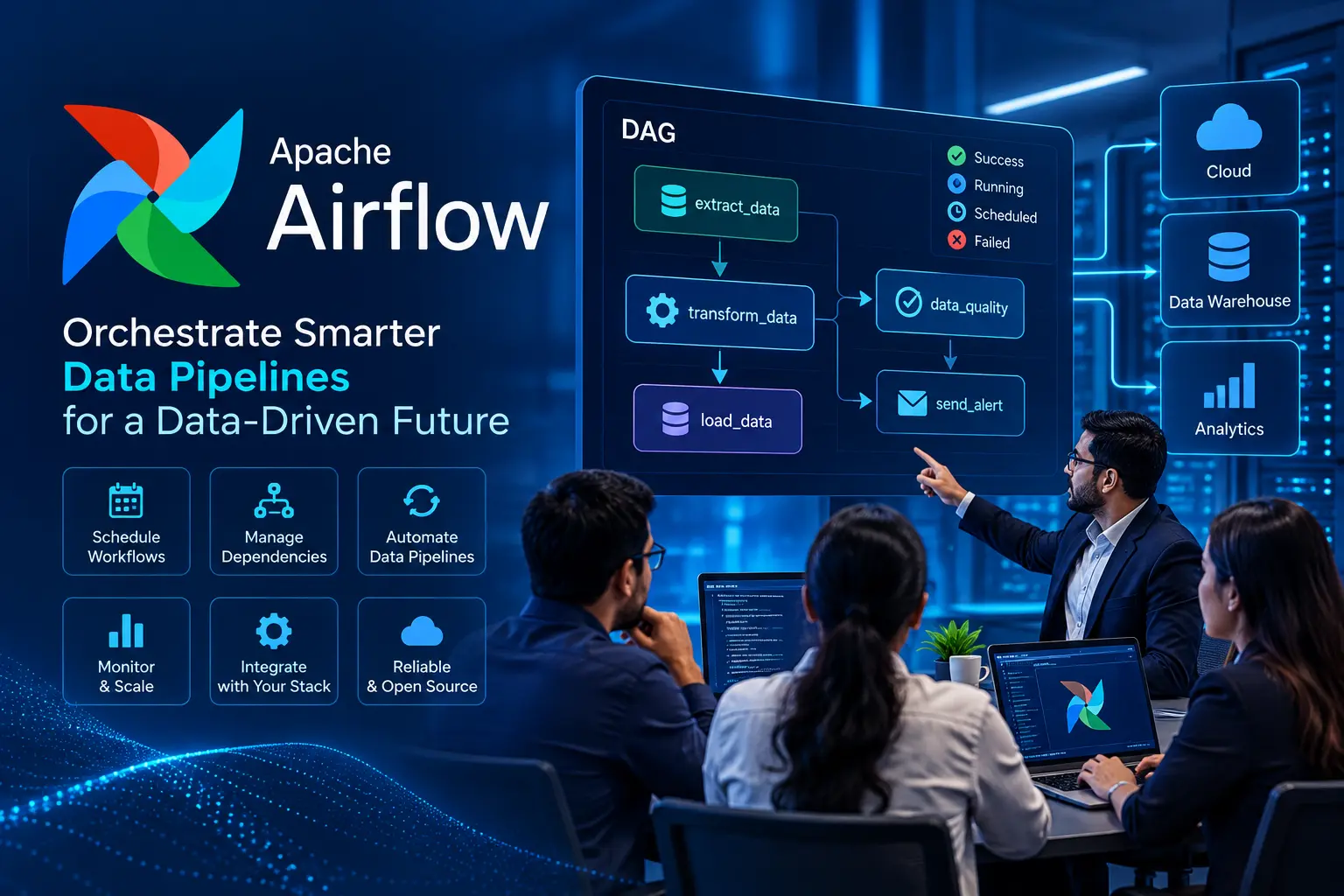
Design clear, reusable workflows with dependencies and task relationships.
Build scheduled and event-oriented data workflows around business needs.
Automate SQL, Python, API, ETL and data-platform processing tasks.
Use logs, task status, retries and alerts to operate workflows reliably.
Apply orchestration patterns to real corporate data engineering environments.
Apache Airflow training at Crystalspiders focuses on practical workflow orchestration for enterprise data engineering teams. Participants learn how to model workflows as DAGs, define tasks and dependencies, schedule pipeline runs, manage integrations, handle failures and operate pipelines with logs and monitoring.
Build readable DAGs, tasks, dependencies, task groups and reusable workflow patterns.
Work with schedules, manual triggers, dependency rules and practical pipeline timing strategies.
Use Python-based task patterns and TaskFlow-style DAG development for maintainable workflows.
Connect workflows with databases, APIs, files, cloud services, ETL tools and data platforms.
Use retries, task states, logging and operational practices to make data pipelines more resilient.
Track workflow execution, investigate failures and establish practical monitoring routines.
The curriculum can be tailored to your team's existing data platform, engineering standards and workflow automation requirements.
Coordinate extraction, transformation, validation and loading workflows across enterprise systems.
Automate file arrivals, API ingestion, validation and downstream processing steps.
Orchestrate data movement and transformation workflows across cloud and hybrid environments.
Schedule data preparation workflows that feed BI, reporting and analytics platforms.
Bring repeatable automation, version-controlled DAG development and operational discipline to data teams.
Design retry, rerun and dependency patterns that help teams manage workflow failures systematically.
The course can be configured around the technologies your teams use in production and the integration points that matter to your organization.
Apache Airflow is widely used to define and orchestrate programmatic workflows. Corporate Apache Airflow training helps teams move from manually coordinated jobs to repeatable workflows built around DAGs, tasks, schedules, dependencies and operational visibility.
This training covers practical Airflow concepts such as DAG authoring, scheduling, operators, sensors, TaskFlow-style development, connections, variables, XCom, logging, retries and workflow monitoring. Participants can apply these concepts to SQL pipelines, Python workloads, APIs, ETL processes, cloud data movement and analytics preparation.
For teams building larger data platforms, the program can also address maintainable DAG structures, testing practices, failure recovery, deployment workflows and operational standards. The goal is to help engineering teams create data workflows that are understandable, repeatable and easier to support.
The program covers Airflow fundamentals, DAG design, task dependencies, scheduling, operators, sensors, TaskFlow patterns, connections, variables, XCom, retries, logging, monitoring, testing and production-oriented workflow orchestration.
The training is suitable for data engineers, ETL developers, Python developers, analytics engineers, platform teams and technical professionals who build or support scheduled data pipelines.
Yes. The program is designed around practical DAG development, task dependencies, scheduling patterns, reusable task logic, failure handling, testing and monitoring of data workflows.
Yes. Participants learn scheduling concepts, cron-based schedules, task dependencies, trigger patterns, retries, execution dates or logical scheduling concepts, and practical dependency design.
Yes. Connections and Variables are covered for configuration and integration, while XCom concepts are covered for lightweight communication between tasks in a workflow.
Yes. Corporate delivery can be aligned to your team's data sources, ETL workflows, Python or SQL workloads, deployment model, monitoring requirements and preferred engineering practices.
Discuss your data platform, pipeline requirements and preferred delivery format with Crystalspiders.