Open-Source ETL Architecture
Pipeline design, components, reusable flows, staging patterns, environment separation and maintainable integration architecture.
Equip your teams with practical skills to design and operate open-source ETL and data-integration solutions. The training covers database, file and API connectivity, pipeline orchestration, transformations, validation, monitoring, troubleshooting and production-ready integration practices.
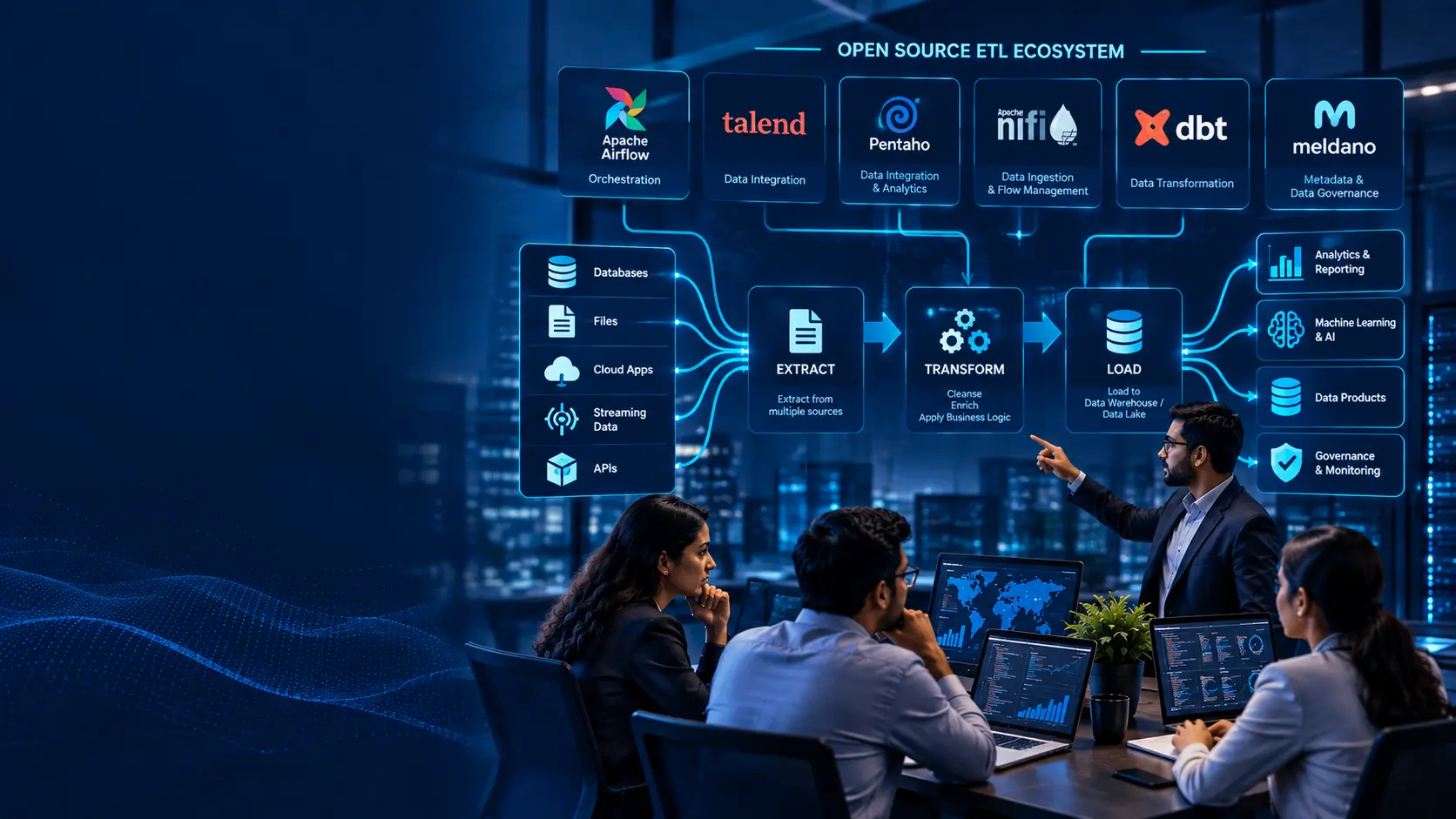
Databases, files and APIs
Reusable integration workflows
Flexible tooling choices
Reliable production pipelines
Validation and exception handling
Open Source ETL Tools training is designed for teams that want practical experience building data pipelines without being tied to a single commercial ETL platform. Participants explore reusable integration patterns for databases, flat files, APIs, cloud and object-storage sources, transformation workloads and analytical targets.
Corporate delivery can be tailored to the organization's architecture and project needs, with hands-on exercises focused on ingestion, transformation, routing, scheduling, monitoring, troubleshooting and operational support.
The curriculum can be customized around your organization's tools, data architecture and project requirements.
Pipeline design, components, reusable flows, staging patterns, environment separation and maintainable integration architecture.
Flow-based integration, processors, routing, prioritization, back pressure, provenance and practical pipeline design.
Connector-driven ingestion patterns, source-target synchronization, configuration and integration workflows.
Pipeline and workflow concepts, transformations, metadata-driven development and visual data-integration patterns.
Relational sources and targets, SQL execution, staging, incremental extraction and dependable data movement patterns.
CSV, JSON, delimited files, batch ingestion and object-storage based integration scenarios.
HTTP requests, authentication considerations, pagination, JSON processing, retries and API-to-database pipelines.
Completeness, duplicate detection, business-rule validation, source-target reconciliation and controlled rejects.
Watermarks, high-water marks, change detection and efficient processing of newly arrived or changed data.
Dependencies, schedules, retries, operational sequencing and integration with workflow-orchestration platforms.
Logs, metrics, alerts, failure analysis, recovery procedures and production support practices.
Pipeline validation, test data, regression checks, configuration management and controlled deployment practices.
The course focuses on how teams can combine connectors, transformations, routing, orchestration, validation and monitoring into dependable enterprise data flows.
Identify source systems, connectors, formats and authentication requirements.
Bring source data into controlled flows with appropriate batching and routing.
Clean, standardize, enrich and map data for downstream use.
Apply quality checks, reconciliation and exception handling.
Schedule workflows, manage dependencies and design retry paths.
Track execution, failures, throughput and operational health.
Typical scenarios include data ingestion, platform integration, migration, analytics enablement and automated operational workflows.
Move and synchronize data across SQL Server, PostgreSQL, Oracle and other relational environments.
Connect enterprise applications, APIs and shared data services through reusable workflows.
Ingest and stage data from cloud services and object-storage based sources.
Automate CSV, JSON and scheduled file-processing pipelines with validation and exception paths.
Prepare trusted data for warehouses, dashboards, reporting and downstream analytics.
Support migration and modernization initiatives with repeatable ingestion and validation workflows.
Corporate programs can focus on the technologies your teams already use or are evaluating. Tool combinations can be selected according to your architecture, migration plans, integration workload and operating model.
The emphasis remains on transferable data-integration concepts so teams can apply the patterns across multiple open-source tools and enterprise platforms.
Build reusable open-source integration pipelines and improve production practices.
Extend SQL and database skills into enterprise data movement and integration.
Strengthen ingestion, transformation, orchestration and operational engineering patterns.
Improve upstream data preparation for reporting and analytics workloads.
Standardize application, API and data integration approaches.
Evaluate tooling, architecture, supportability and delivery standards for integration teams.
Design maintainable ETL and data-integration pipelines using open-source tools.
Connect databases, files, APIs and heterogeneous enterprise sources.
Build reusable ingestion, transformation, routing and validation flows.
Introduce scheduling, orchestration, retries and dependency management.
Improve monitoring, troubleshooting, quality controls and production support.
Evaluate open-source ETL options using practical architecture and project criteria.
Crystalspiders corporate Open Source ETL Tools training helps teams develop practical skills for building data pipelines with open-source technologies. The program covers data ingestion, transformation, routing, orchestration, validation, monitoring and production support across databases, files, APIs and analytical systems.
Depending on the organization's needs, the training can include hands-on work with Apache NiFi, Airbyte, Apache Hop and related open-source integration approaches. The emphasis is on reusable pipeline design, connector selection, data movement patterns, operational visibility and maintainable implementation rather than a single tool alone.
Open-source ETL skills are also useful in broader Data Engineering initiatives. Teams can connect this training with Advanced ETL & Data Integration, Apache Airflow, dbt & Modern ELT, Databricks and Power BI & Data Analytics training to create a progressive enterprise learning path.
Corporate delivery can be adapted for developers, data engineers, BI teams, integration specialists, technical leads and architects. Training exercises can use representative organizational datasets and workflows so participants can relate ETL concepts to real implementation and operational scenarios.
Common questions about corporate open-source ETL and data-integration training.
It is a corporate training program focused on using open-source technologies and patterns to build, automate, monitor and maintain ETL and data-integration pipelines across databases, files, APIs and other enterprise data sources.
The program can be tailored around tools such as Apache NiFi, Airbyte, Apache Hop and related open-source data-integration technologies. Tool selection can be aligned to the organization's architecture, project requirements and preferred technology stack.
Workflow orchestration can be included where it supports the organization's data pipelines. Apache Airflow is primarily an orchestration platform, so it can be covered alongside ETL and integration tools for scheduling, dependencies, retries and pipeline operations.
Yes. Practical exercises can cover relational databases, CSV and other files, REST APIs, cloud or object storage sources, staging areas and downstream analytical targets.
Yes. Corporate delivery can be customized around your source systems, target platforms, integration patterns, security requirements, development standards, deployment process and representative business use cases.
Yes. The curriculum can include logging, pipeline monitoring, retries, failure handling, data validation, operational dashboards, troubleshooting practices and production support considerations.
Discuss your current ETL environment, preferred tools, project requirements and delivery format with Crystalspiders.