Prompt Engineering Foundations
Understand prompts, instructions, context, constraints, objectives, response formats and the fundamentals of effective LLM interaction.
Equip your teams with practical prompt engineering skills to communicate effectively with large language models, structure AI tasks, improve response quality and build reliable generative AI workflows for real business use cases.
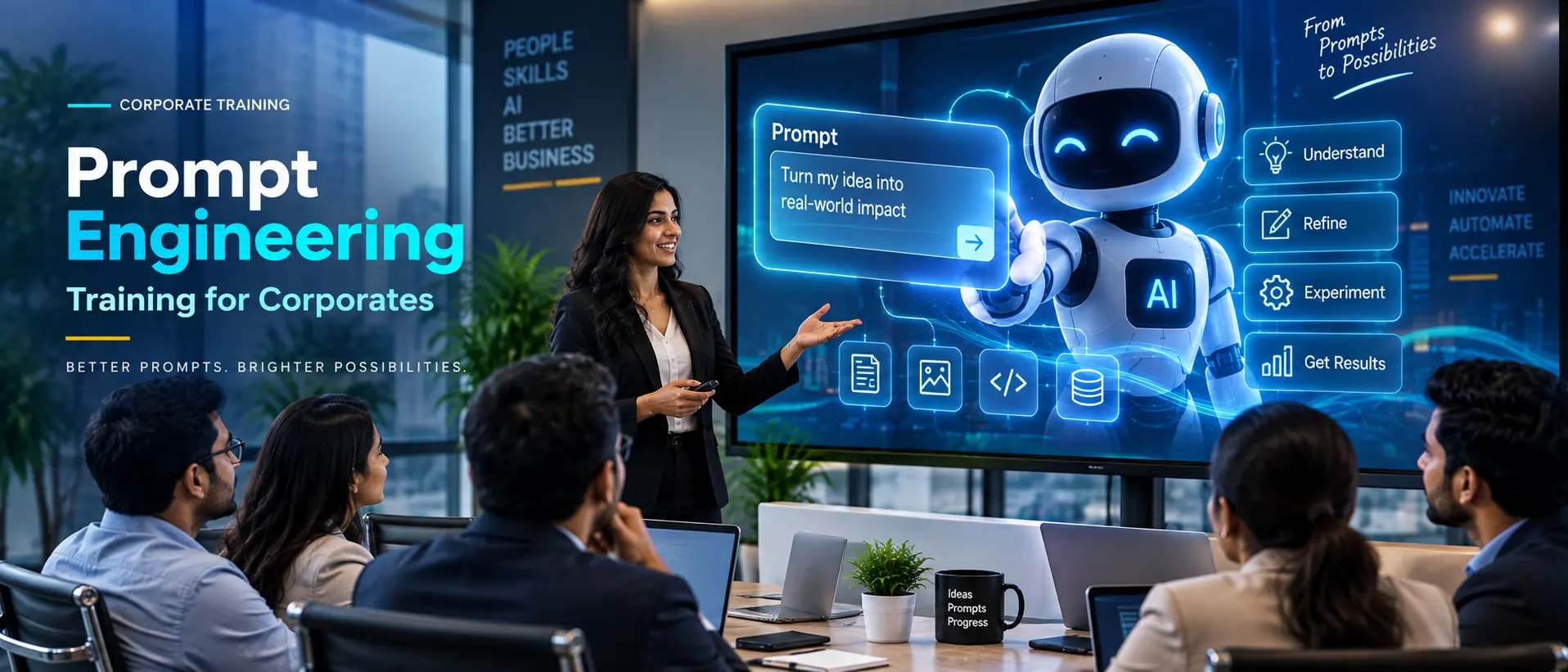
Prompt engineering is the practice of designing clear, structured instructions and useful context so that generative AI systems can produce more relevant, consistent and actionable outputs.
This corporate Prompt Engineering training helps teams move beyond simple question-and-answer interactions and develop repeatable prompting approaches for analysis, content generation, coding, research, summarization, transformation and business workflows.
The program can be tailored for developers, analysts, business users, product teams, technical leads and organizations adopting large language models and enterprise generative AI applications.
Learn how to design prompts that clearly define the task, context, constraints, desired output and evaluation criteria.
Practical modules covering prompt design, LLM interaction patterns, context management, structured responses and prompt optimization for enterprise generative AI workflows.
Understand prompts, instructions, context, constraints, objectives, response formats and the fundamentals of effective LLM interaction.
Build prompts using reusable structures for role, task, context, constraints, examples, output requirements and quality criteria.
Learn when to use direct instructions, examples and demonstrations to improve task understanding and output consistency.
Design prompts for structured text, JSON-style responses, classifications, extraction, transformations and repeatable business outputs.
Improve prompts by selecting the right context, organizing information, managing instructions and reducing irrelevant or conflicting input.
Create prompts for code generation, explanation, debugging, refactoring, testing, documentation and developer productivity workflows.
Structure AI-assisted analysis tasks for summarization, comparison, classification, insight extraction and business decision support.
Test alternative prompts, diagnose weak outputs, refine instructions and establish repeatable approaches for improving prompt quality.
Define expected outputs, test prompts against representative examples, compare results and establish practical evaluation criteria.
Explore safe prompt practices, sensitive information handling, instruction boundaries, human review and enterprise governance.
Create standardized prompt templates and reusable patterns for customer support, reporting, documentation, research and operations.
Apply prompt engineering to real corporate use cases and integrate AI prompts into repeatable applications, processes and team workflows.
Teams can practice prompt engineering across common enterprise activities where generative AI can assist with content, analysis, coding, knowledge work and repetitive information tasks.
Design prompts for response drafting, summarization, classification and consistent customer communication.
Extract information, summarize documents, transform content and generate structured business reports.
Support code generation, debugging, test creation, documentation and developer productivity.
Build prompts for information synthesis, comparison, categorization, insight extraction and analytical workflows.
Assist with role descriptions, policy summaries, process documentation, internal communication and operational knowledge tasks.
Create reusable prompts for content generation, customer insights, campaign ideas, summaries and communication workflows.
The training can be adapted to the models, tools and applications used by your organization rather than being tied to a single platform.
Participants can apply prompt engineering patterns to make AI interactions clearer, more consistent and more aligned with business requirements.
We can align the training depth, exercises and examples with your team's current AI capabilities, business processes and preferred technology stack.
Structured sessions with live demonstrations, guided exercises and practical discussion of prompt engineering patterns.
Practice prompt design, optimization, structured output and evaluation using realistic business scenarios.
Customize examples for software development, analytics, operations, support, documentation, research and other business workflows.
Discuss prompt standards, reusable templates, evaluation approaches and practical ways teams can adopt generative AI.
Build practical prompt engineering capability for teams using large language models across software development, analysis, documentation, research and business workflows.
Crystalspiders provides corporate Prompt Engineering training for organizations that want their teams to use large language models more effectively and consistently. The program focuses on designing clear instructions, selecting relevant context, defining constraints, specifying output formats and creating repeatable prompts for real enterprise work.
Corporate prompt engineering training can cover zero-shot and few-shot prompting, prompt design frameworks, structured outputs, context engineering, prompt templates, prompt optimization and prompt testing. Teams can apply these techniques to coding, analysis, content generation, document processing, research, summarization and other generative AI-assisted workflows.
The curriculum can be customized for software developers, Python developers, analysts, product teams, business users, technical leads, architects and AI professionals. Examples and exercises can be aligned with your organization's applications, business processes, data sources and preferred LLM platforms.
The training also addresses practical prompt evaluation and governance. Teams can define expected outputs, compare prompt variants, improve consistency, identify weak responses and establish reusable prompt standards for enterprise use.
This corporate Prompt Engineering training is designed to help teams move from ad-hoc prompting toward structured, repeatable AI workflows that better match business requirements and enterprise application needs.
Common questions about corporate Prompt Engineering training, LLM prompt design, context engineering, prompt optimization and enterprise AI workflows.
Prompt Engineering training teaches teams how to design clear instructions, provide useful context, define constraints and structure outputs when working with large language models and generative AI applications.
The program can be designed for developers, analysts, technical leads, architects, product teams, business users and professionals who use or plan to use generative AI in their work.
Yes. Prompt Engineering can be taught at a business-user level or a technical level depending on the team's responsibilities and intended AI use cases.
Yes. Corporate sessions can be tailored around relevant business workflows, examples and exercises so participants can practice with scenarios that are meaningful to their teams.
Yes. The curriculum can cover context selection and organization, zero-shot and few-shot prompting, examples, constraints and reusable prompt structures for different LLM tasks.
Yes. Teams can learn how to test prompts against representative examples, compare outputs, diagnose weaknesses, refine instructions and establish repeatable prompt evaluation practices.
Discuss a customized Prompt Engineering training program for your organization, team size, business workflows and AI adoption goals.