AI Agent Foundations
Agent concepts, architectures, agent loops, goals, actions, observations, decision making and practical enterprise use cases.
Equip your technology and business teams with practical skills to design, build and deploy intelligent AI agents that can reason, use tools, access enterprise knowledge and automate multi-step workflows.
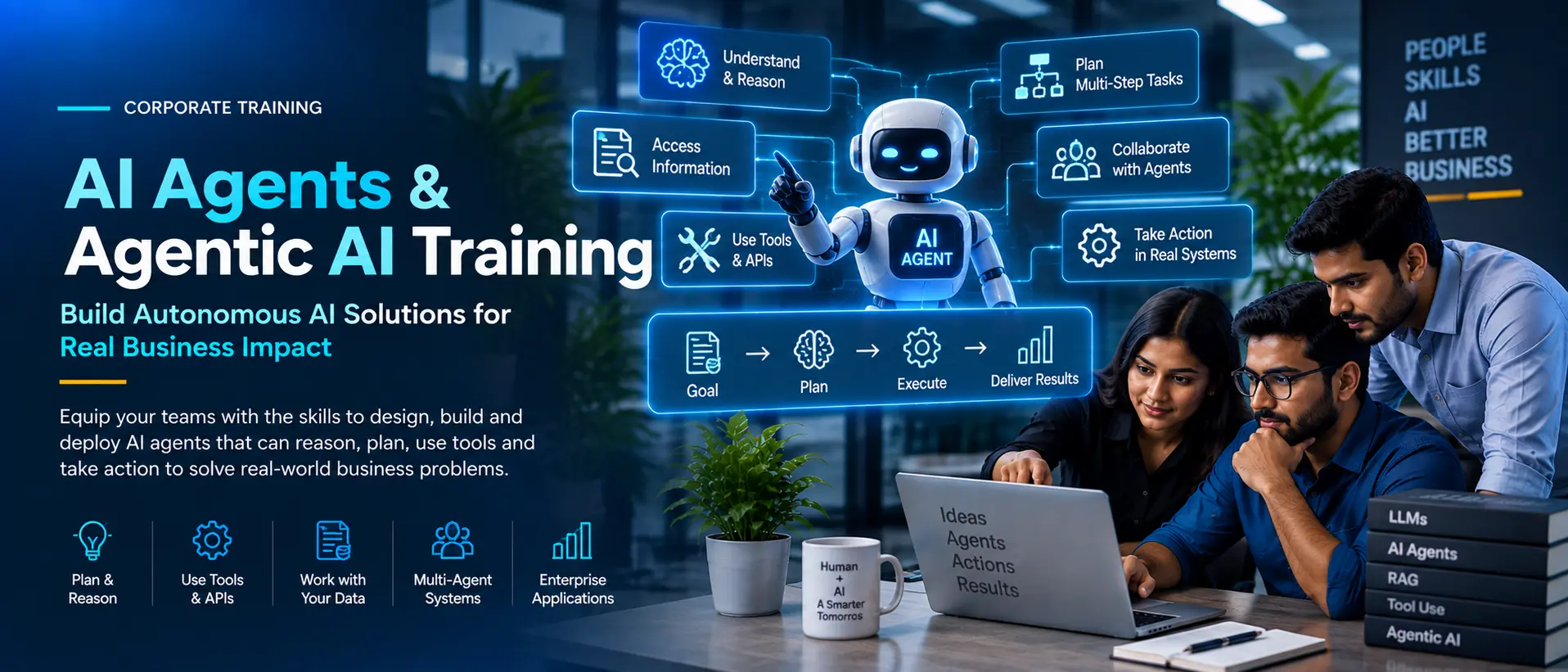
Generative AI can create content, answer questions and summarize information. Agentic AI extends that capability by allowing AI systems to plan tasks, select tools, interact with applications and complete multi-step processes.
This corporate training helps teams understand AI agent architecture and engineering patterns and apply them to practical enterprise scenarios. Key areas include AI agent development, agentic AI architecture, LLM-powered workflows, tool and function calling, RAG, agent memory, multi-agent orchestration and enterprise AI automation.
The program can be tailored for developers, data professionals, architects, technical leads and teams exploring AI-powered automation.
Learn how an AI application can evolve from a simple prompt-response workflow into a grounded, tool-using and orchestrated agentic system.
Practical modules designed to help teams understand, build and integrate agentic AI solutions into real business workflows.
Agent concepts, architectures, agent loops, goals, actions, observations, decision making and practical enterprise use cases.
LLM capabilities, context, structured outputs, model selection and using language models as reasoning and orchestration components.
Design tool interfaces that allow agents to call APIs, databases, business applications and custom functions.
Task decomposition, planning patterns, routing, conditional execution, retries and controlled multi-step workflows.
Connect agents to enterprise documents and knowledge sources using retrieval, embeddings, vector databases and grounded responses.
Conversation state, short-term and long-term memory patterns, context management and maintaining useful agent state.
Design specialized agents, delegation patterns, agent collaboration, handoffs and coordinated multi-agent workflows.
Agent evaluation, traceability, access controls, safety boundaries, human approval points and production governance considerations.
APIs, backend services, observability, error handling, deployment patterns and integrating AI agents with existing enterprise applications.
Training can be aligned with your organization's preferred AI and application stack instead of following a one-size-fits-all technology path.
Teams can use the concepts from the program to identify suitable agentic workflows, design solution architectures and build controlled AI automation.
Build practical capability in AI agent development, agentic workflows, tool use, enterprise knowledge integration and controlled AI automation.
Crystalspiders provides corporate AI Agents and Agentic AI training for technology teams that want to move beyond simple prompt-response applications and understand how intelligent agents can plan tasks, use tools, access information and execute multi-step workflows.
The training can cover AI agent architecture, LLM-powered workflows, tool and function calling, planning, routing, RAG, embeddings, vector databases, memory, multi-agent collaboration and orchestration. Teams can learn how these building blocks fit together when designing AI-powered enterprise applications.
Corporate Agentic AI training can be customized for software developers, Python developers, data engineers, AI and ML engineers, solution architects, technical leads and teams working on AI automation. Examples can be adapted to internal support, knowledge discovery, data workflows, business process automation and application integration.
The program can also address evaluation, guardrails, access controls, observability, human approval points and production considerations so teams can design AI agents that are easier to test, monitor and integrate with existing enterprise systems.
This corporate AI Agents training is designed to help organizations build a practical foundation for Agentic AI adoption while connecting AI models with APIs, databases, backend services and real business workflows.
Common questions about AI agent development, Agentic AI training, RAG, tool calling, memory, multi-agent systems and enterprise AI automation.
The program can cover AI agent foundations, agent architecture, LLM-powered workflows, tool and function calling, planning, RAG, memory, multi-agent systems, orchestration, evaluation, guardrails and enterprise AI automation.
The training can be tailored for software developers, Python developers, data engineers, AI and ML engineers, solution architects, technical leads, engineering managers and teams building AI-powered applications.
Yes. Modules, examples, labs and use cases can be aligned with your organization's technology stack, application landscape, business workflows, data sources and AI adoption goals.
Yes. Teams can learn how agents interact with APIs, databases, business applications and custom functions through structured tool and function calling patterns.
Yes. The program can cover enterprise knowledge grounding with RAG, embeddings and vector databases, along with short-term and long-term memory and context management patterns.
Yes. Depending on scope, teams can explore specialized agents, delegation, handoffs, orchestration, evaluation, guardrails, observability, deployment and integration with enterprise backend services.
We can align the depth, duration and hands-on exercises with your team's current skills, technology stack and AI adoption goals.
Structured training with live explanation, demonstrations and guided technical discussions.
Build agent workflows, tool integrations, RAG pipelines and practical AI application components.
Adapt examples to internal support, knowledge discovery, data workflows, business automation and application integration.
Discuss solution patterns, technology choices, integration approaches and production considerations.
Discuss a customized AI Agents and Agentic AI training program for your organization, team size and technology environment.