Generative AI Fundamentals
Understand foundation models, tokens, context, embeddings and the main concepts behind Generative AI systems.
Equip technology and business teams with practical Generative AI skills to work with large language models, prompt engineering, retrieval-augmented generation, AI agents, intelligent applications, evaluation and enterprise AI adoption.
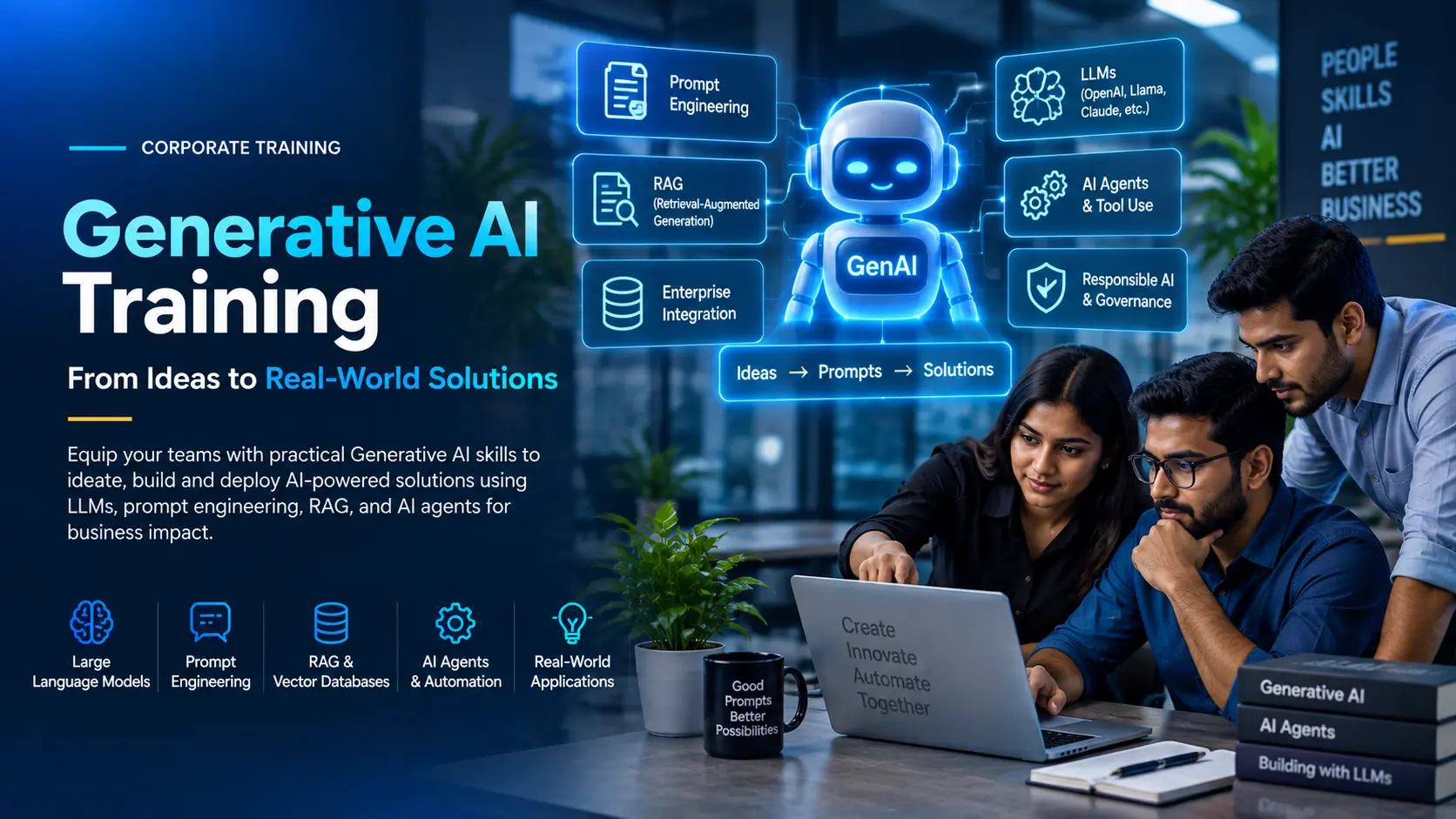
Core concepts and applications
Language models and AI workflows
Design effective AI interactions
Ground AI with enterprise data
Build task-oriented AI workflows
Develop the skills required to design, build, evaluate and operationalize modern Generative AI solutions for enterprise use cases.
Understand foundation models, tokens, context, embeddings and the main concepts behind Generative AI systems.
Learn practical LLM concepts, model interaction patterns, context management and common enterprise language workflows.
Design structured prompts, reusable prompt patterns and evaluation approaches for reliable AI-assisted tasks.
Build grounded AI experiences using documents, embeddings, retrieval workflows and enterprise knowledge sources.
Understand agentic patterns, tool use, workflow orchestration and task-oriented AI applications.
Apply practical approaches to AI evaluation, data security, governance, reliability and responsible enterprise adoption.
The curriculum can be customized for developers, data professionals, analysts, architects, business teams and technical leaders.
A structured corporate learning model aligned with your team's roles, business priorities, data environment and Generative AI objectives.
Review business priorities, team roles, workflows and potential Generative AI use cases.
Align modules, examples and labs with your organization's AI technology environment.
Practice prompts, RAG workflows, agents, integrations and AI application scenarios.
Evaluate team capability, solution understanding and readiness for responsible adoption.
Crystalspiders provides corporate Generative AI training for organizations that want practical capability in large language models, prompt engineering, retrieval-augmented generation, AI agents and intelligent application development. The program can be structured around the team's current AI maturity, technology environment and business objectives.
Corporate GenAI training can cover foundation models, tokens, context, embeddings, structured prompts, prompt evaluation, semantic retrieval and RAG workflows. Teams can also explore how AI agents use tools, application integrations and multi-step workflows to support practical enterprise scenarios.
The curriculum can be customized for software developers, data professionals, analysts, architects, business teams and technical leaders. Learning paths can focus on GenAI awareness, application development, enterprise knowledge assistants, document workflows, AI automation or other organization-specific use cases.
The delivery model emphasizes hands-on labs, realistic enterprise scenarios and project-oriented learning so participants can connect Generative AI concepts with application architecture, data integration, evaluation, security, governance and operational considerations.
This corporate Generative AI training is designed to help teams build a practical foundation for responsible GenAI adoption and develop the technical and business understanding needed to evaluate, prototype and improve AI-powered solutions.
Common questions about corporate GenAI training, LLMs, RAG, AI agents, curriculum customization and hands-on enterprise learning.
The program can cover Generative AI fundamentals, large language models, prompt engineering, embeddings, retrieval-augmented generation, AI agents, application development, evaluation, governance and responsible enterprise adoption.
The training can be tailored for software developers, data professionals, analysts, architects, business teams, technical leaders and other professionals working with or planning to adopt Generative AI.
Yes. Modules, examples, labs and projects can be aligned with your team's roles, technology environment, business objectives, data landscape and preferred Generative AI use cases.
Yes. The curriculum can cover large language model concepts, tokens, context, embeddings, structured prompting, reusable prompt patterns and practical evaluation approaches.
Yes. RAG topics can include document ingestion, chunking, embeddings, semantic retrieval and grounded AI workflows that connect language models with enterprise knowledge sources.
Yes. Depending on the program scope, teams can learn agentic workflows, task planning, tool calling, application integration and multi-step AI workflow patterns.
Discuss your team's roles, AI objectives, technology environment and preferred corporate training model with our training team.