Data Preparation & Exploration
Prepare datasets, handle missing values and outliers, explore patterns and create useful inputs for machine learning workflows.
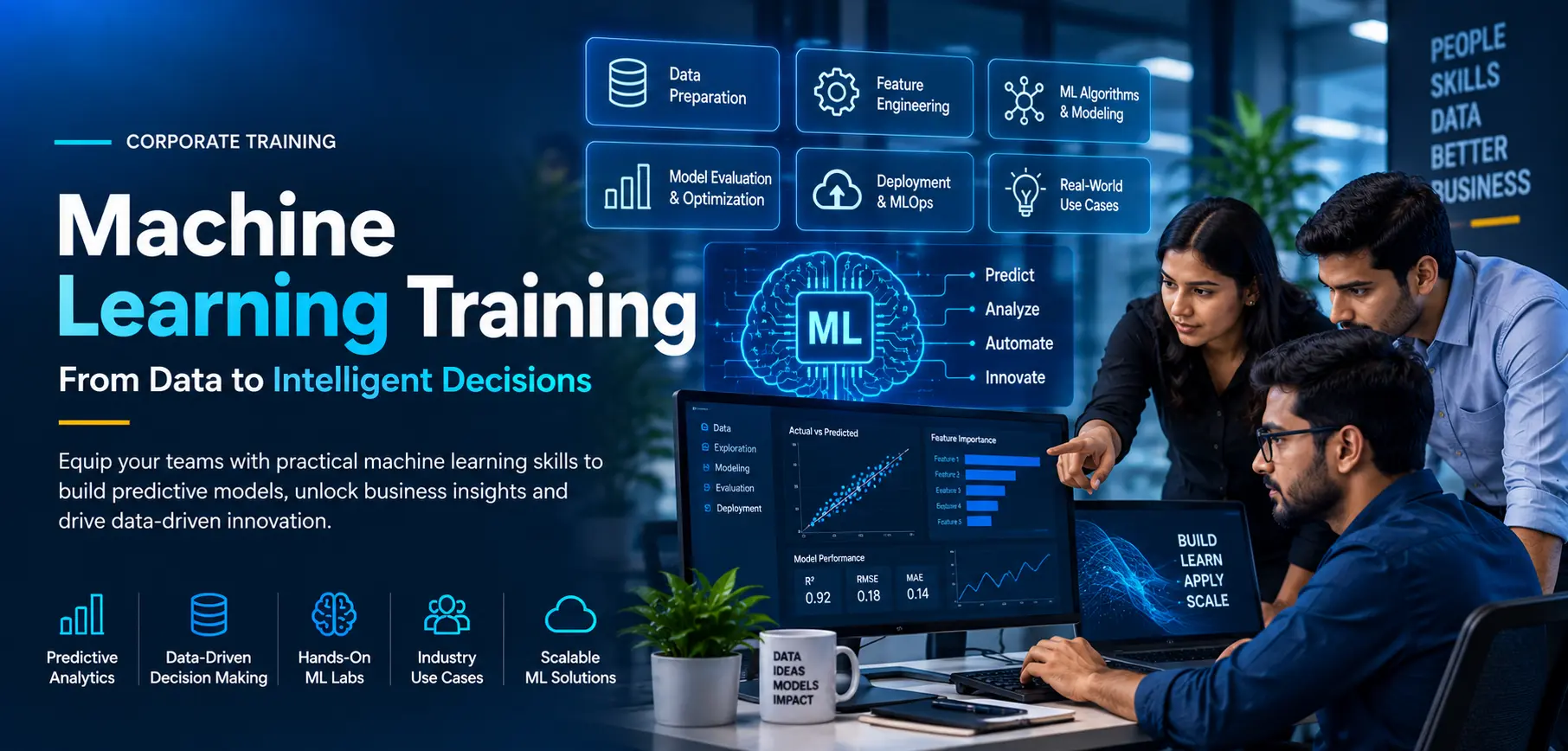
Equip your teams with practical Machine Learning skills to prepare data, engineer features, build and evaluate models, interpret results and develop production-oriented machine learning solutions using Python and modern ML practices.
Prepare quality data for ML workflows
Build practical machine learning solutions
Understand and apply core algorithms
Measure model quality and performance
Apply practical deployment concepts
Develop the skills required to prepare data, train models, evaluate results and translate machine learning techniques into practical business solutions.
Prepare datasets, handle missing values and outliers, explore patterns and create useful inputs for machine learning workflows.
Create, transform and select features that help machine learning models learn useful patterns from business data.
Work with classification, regression, clustering and other practical machine learning approaches for common business problems.
Select appropriate metrics, evaluate model performance, identify overfitting and improve models through practical tuning techniques.
Structure machine learning experiments, compare approaches, track results and develop reproducible model development workflows.
Understand model deployment, monitoring, retraining, versioning and operational practices needed for production machine learning.
The curriculum can be customized for data scientists, data analysts, Python developers, engineers, architects and technical teams.
A structured corporate learning model aligned with your team's roles, data environment, technology stack and machine learning objectives.
Review business problems, available data, team roles and current machine learning requirements.
Align concepts, examples and labs with your organization's datasets, projects and technology environment.
Practice data preparation, feature engineering, model development, evaluation and deployment scenarios.
Evaluate ML skills, project understanding and readiness for practical machine learning implementation.
Crystalspiders provides corporate Machine Learning training for organizations that want practical skills for developing, evaluating and applying machine learning solutions. The program can cover Machine Learning fundamentals, Python for ML, data preparation, exploratory data analysis, feature engineering, supervised and unsupervised learning and practical model development workflows.
Corporate ML training can help teams work through the complete machine learning workflow, from defining business problems and preparing datasets to selecting algorithms, training models, evaluating performance and improving results. Topics can include regression, classification, clustering, ensemble methods, cross-validation, overfitting and hyperparameter tuning.
The curriculum can be customized for data scientists, data analysts, Python developers, data engineers, software engineers, architects and technical teams. Training can be aligned with your organization's datasets, applications, technology stack and machine learning use cases.
For teams moving models toward production, the program can include deployment concepts, model serving, monitoring, versioning, retraining and practical machine learning lifecycle considerations. The delivery approach emphasizes realistic datasets, hands-on exercises and project-oriented learning.
This corporate Machine Learning training is designed to build practical ML capability across teams while helping participants connect data science concepts, model development and evaluation with real business and technology requirements.
Common questions about corporate ML training, Python for Machine Learning, curriculum customization, model evaluation and production ML learning.
The program can cover machine learning fundamentals, Python for ML, data preparation, exploratory analysis, feature engineering, supervised and unsupervised learning, model evaluation, tuning, deployment and production ML practices.
The training can be tailored for data scientists, data analysts, Python developers, data engineers, software engineers, architects and technical teams working with predictive analytics or machine learning solutions.
Yes. Modules, examples, datasets, exercises and projects can be aligned with your team's roles, technology stack, business objectives and machine learning use cases.
Yes. Python can be used for practical machine learning workflows including data preparation, exploratory data analysis, feature engineering, model development and evaluation.
Yes. Depending on the program scope, teams can learn model evaluation metrics, cross-validation, overfitting, hyperparameter tuning and practical model optimization techniques.
Yes. The curriculum can include model serving, deployment concepts, monitoring, versioning, retraining and practical machine learning lifecycle considerations for production environments.
Discuss your team's roles, datasets, ML objectives, technology environment and preferred corporate training model with our training team.